Research Areas
Data and Simulation Group
Dr. Wei’s group focus on simulations of photonics and molecules, which covers the following fields.
(1) Simulation of Light-Matter Interaction
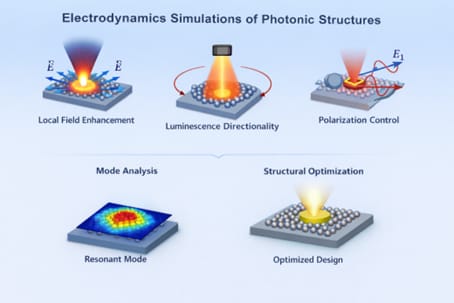
Our group employs electrodynamics simulation software to model light–matter interactions in photonic structures, providing a quantitative framework for understanding their optical responses. These computational tools are systematically applied to analyze key phenomena, including local field enhancement, luminescence directionality, and polarization control, which are critical for tailoring photonic functionalities. Accordingly, a comprehensive evaluation of these effects is essential for elucidating the underlying physical mechanisms and optimizing device performance. Based on these simulations, our group further conducts detailed mode analysis and structural optimization, enabling precise identification of resonant modes and their coupling characteristics. This integrated approach is instrumental in guiding the rational design of photonic structures with enhanced performance and targeted optical properties.
(2) Molecular Excited-State Vibrational Relaxation Analysis
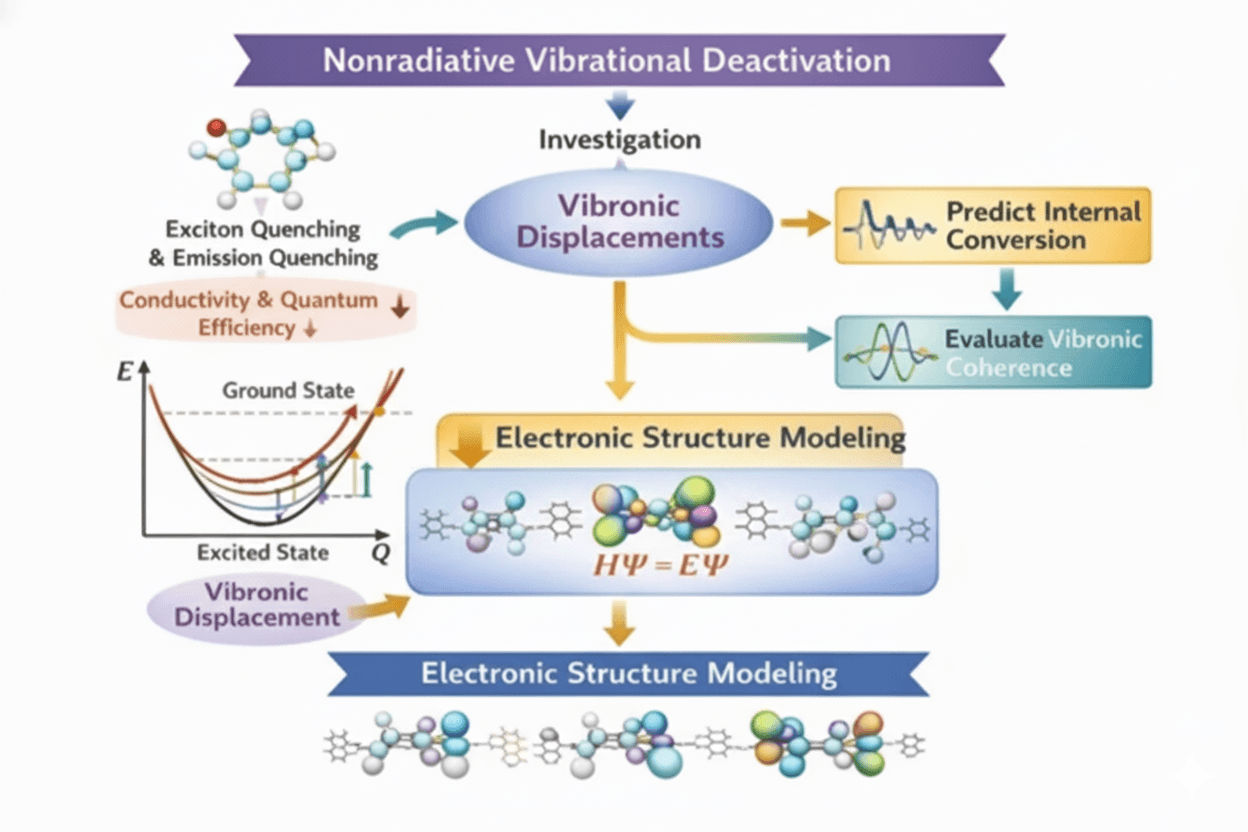
Polyatomic molecules undergo nonradiative vibrational deactivation processes that significantly quench exciton diffusion and emission, thereby reducing conductivity and quantum efficiency. Accordingly, a rigorous analysis of these deactivation pathways is essential for elucidating strategies to effectively suppress them. Based on electronic structure modeling, our group systematically investigates excited-state vibrational deactivation processes through the calculation of molecular vibronic displacements. This framework is critical for quantitatively predicting internal conversion rates and evaluating vibronic coherence in excited states.