Research Areas
Industrial Application Group
The Chou Research Team is primarily dedicated to the molecular engineering of organic semiconductors and high-performance polymer elastomers (electronic skin), as well as the design and development of silicon carbide materials.
Their research encompasses three major application domains as outlined below:
Development of High-Performance Polymer Elastomers and Electronic Skin (e-Skin) Materials
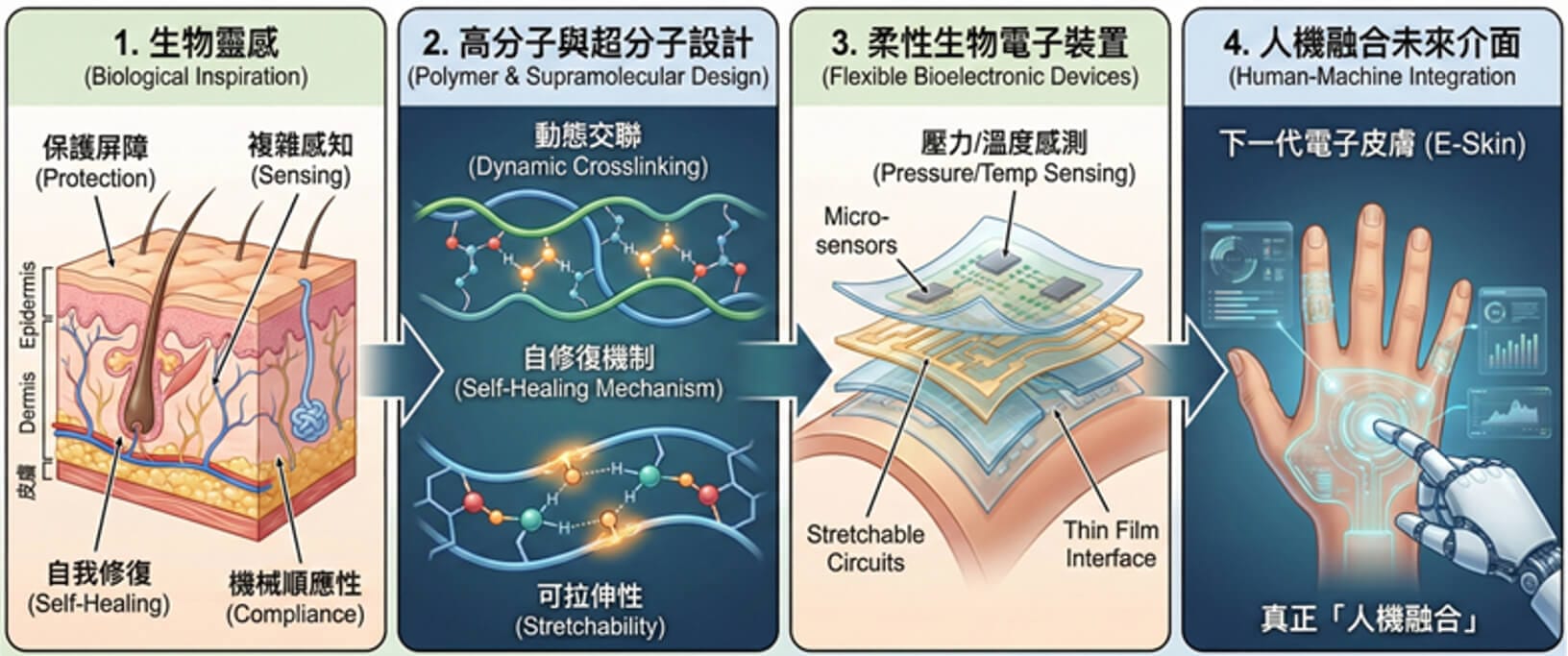
This research team focuses on the design and development of high-performance polymer elastomers and electronic skin (e-skin) materials. Inspired by the multifunctional characteristics of human skin, the team is dedicated to creating advanced materials and devices that integrate high stretchability, self-healing capability, sensing functionality, and biocompatibility.
As the largest organ of the human body, skin simultaneously provides protection, perception, self-repair, and exceptional mechanical compliance, offering an important biomimetic blueprint for next-generation electronic skin materials. Through the design of polymers and supramolecular elastomers with tunable chain segments and dynamic crosslinking networks, the team achieves skin-like softness with high extensibility while maintaining sufficient mechanical strength to withstand external forces.
By leveraging molecular interactions such as metal coordination, hydrogen bonding, ionic bonding, π–π interactions, and dynamic covalent bonds, these materials are endowed with rapid self-healing properties, tunable viscoelastic behavior, and controlled microphase structures. At the same time, material recyclability and sustainable lifecycle applications are also taken into consideration.
Building upon these material innovations, the team further develops skin-like sensing platforms, fabricating stretchable, self-healable, and highly sensitive multimodal sensing devices capable of detecting pressure, strain, and temperature. These technologies are applied to conformable wearable devices and biocompatible interface materials, advancing toward highly integrated and application-oriented electronic skin systems.

Artificial Photosynthesis
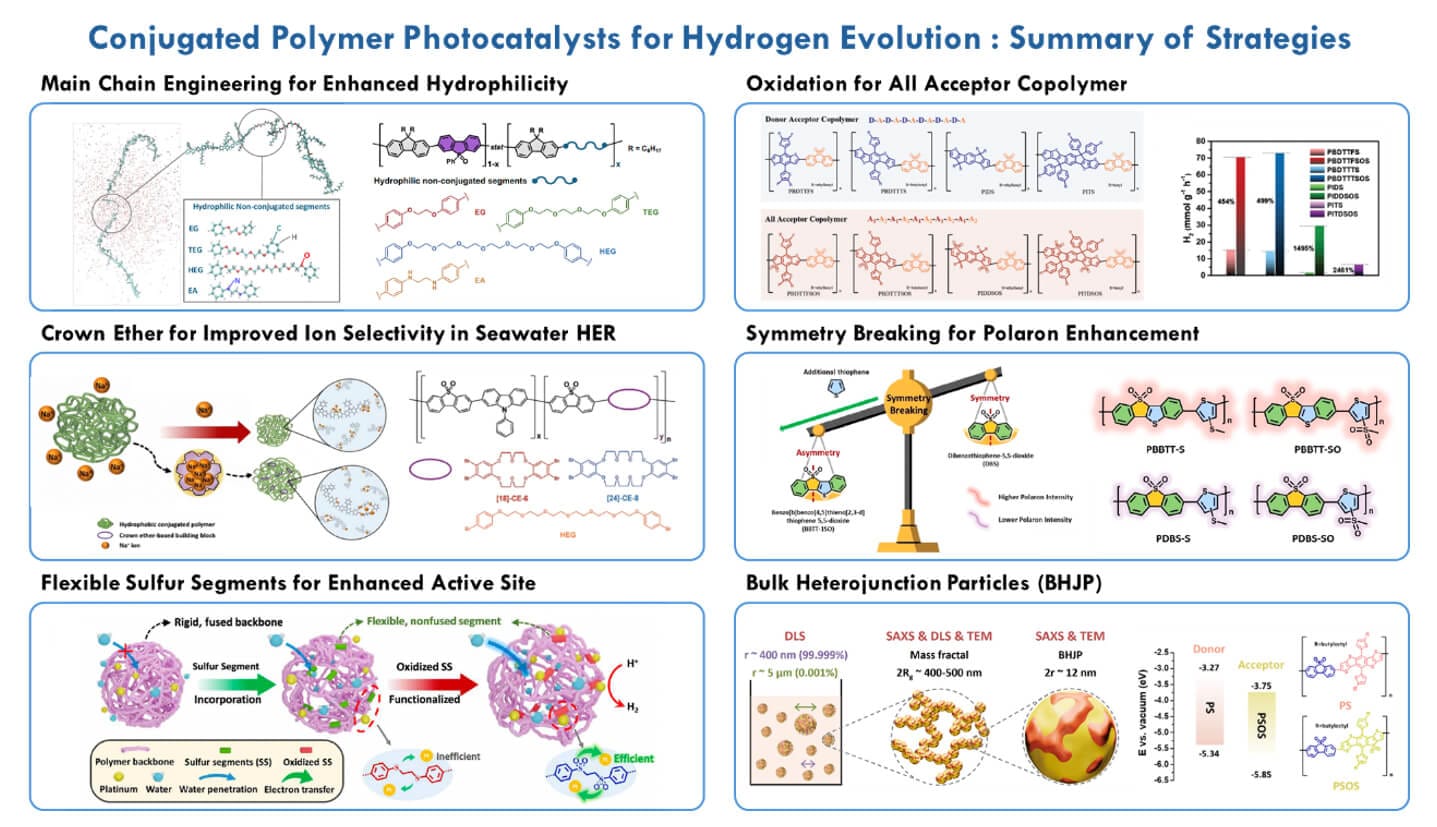
Artificial photosynthesis, inspired by natural photosynthetic processes, utilizes polymer-based photocatalysts to drive water splitting under visible-light irradiation for hydrogen production. This approach is regarded as an environmentally friendly strategy with high energy density and efficient conversion of abundant solar energy.
To identify highly efficient photocatalytic materials capable of mimicking this functionality, the research team is dedicated to the development of novel polymers, covalent organic frameworks (COFs), and polymer dots (Pdots) as active materials for photocatalytic hydrogen evolution from water. The team places strong emphasis on molecular structure design, photophysical characterization, theoretical calculations, reaction mechanism investigations, and hydrogen energy applications.
Beyond water splitting for hydrogen generation, the team is actively advancing photoreforming technologies, employing visible-light-driven polymer photocatalysts to convert plastic waste, biomass feedstocks, and various organic pollutants into hydrogen and value-added chemicals. Photoreforming simultaneously enables waste remediation and energy production, offering higher energy utilization efficiency and presenting forward-looking solutions for the circular economy and sustainable chemistry.
In addition, the team has a strong interest in functional polymer systems for photocatalytic carbon dioxide reduction and overall water splitting reactions. By integrating diverse photocatalytic strategies, the team aims to broaden the applications of artificial photosynthesis in energy conversion and sustainable resource utilization.
Silicon Carbide Research and Applications
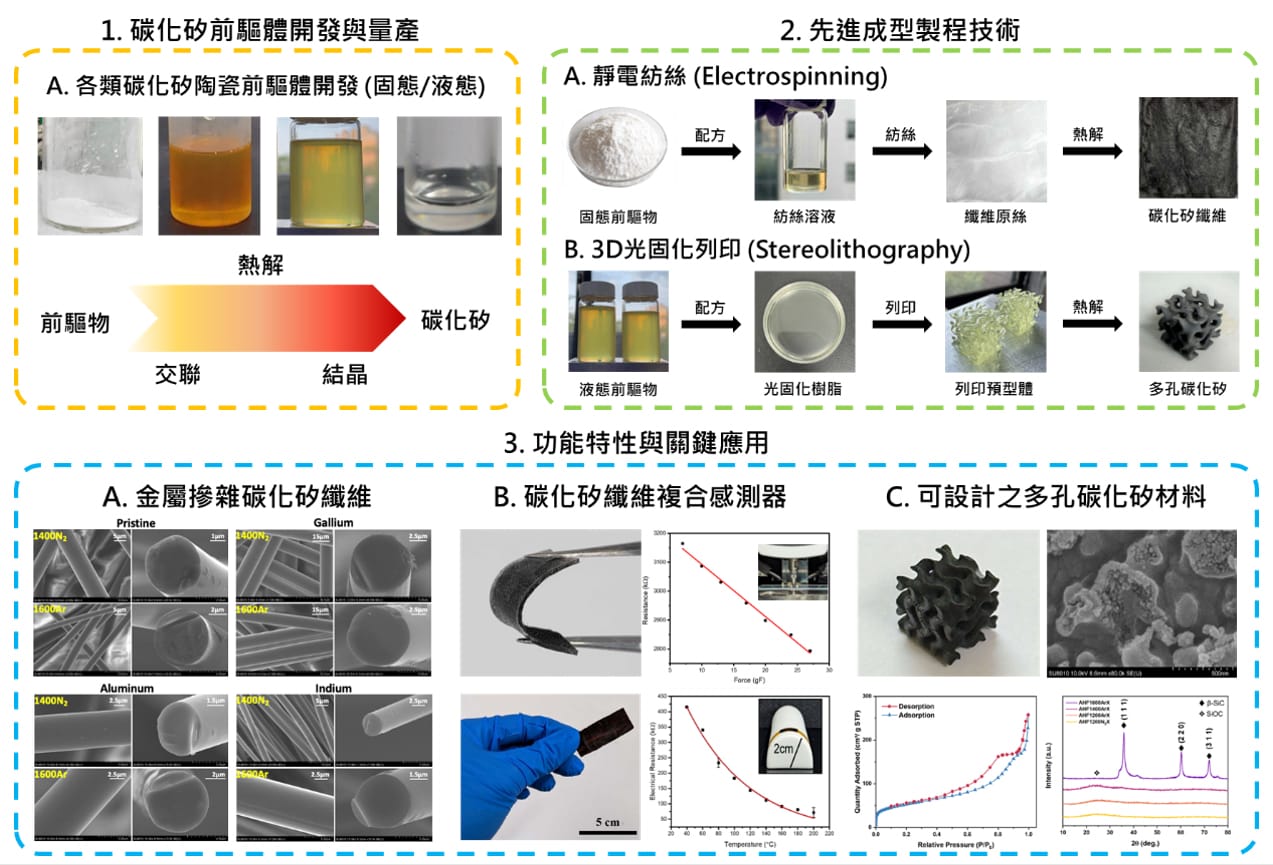
The research team centers its work on silicon carbide (SiC) precursor technologies, possessing comprehensive capabilities in the synthesis, purification, and scalable production of both solid and liquid precursors. Through in-depth understanding of precursor reaction pathways, chemical composition, and pyrolysis behavior, the team has established a fully integrated materials supply platform that supports subsequent shaping processes and high-temperature conversion.
In terms of fabrication, the team integrates two advanced techniques—electrospinning and 3D photopolymerization printing—enabling precursors to be processed into continuous fibers and complex three-dimensional architectures, respectively. Following pyrolysis, these structures are converted into high-temperature-stable silicon carbide ceramics. Through systematic control of formulation and processing parameters, the team is able to produce silicon carbide materials with diverse morphologies and tunable compositions to meet specific structural and performance requirements across various applications.
From an application-oriented perspective, the team focuses on the development of functional silicon carbide materials, including metal-doped SiC fibers with enhanced high-temperature resistance, composite sensing elements incorporating piezoresistive or thermoresponsive functionalities, and porous SiC structures with high surface area and design flexibility suitable for catalytic reactions and operation in extreme environments.
By integrating the pathway of “precursor development → forming technology → functional applications,” the research team has established a comprehensive silicon carbide materials technology chain spanning from chemical synthesis to engineering implementation.